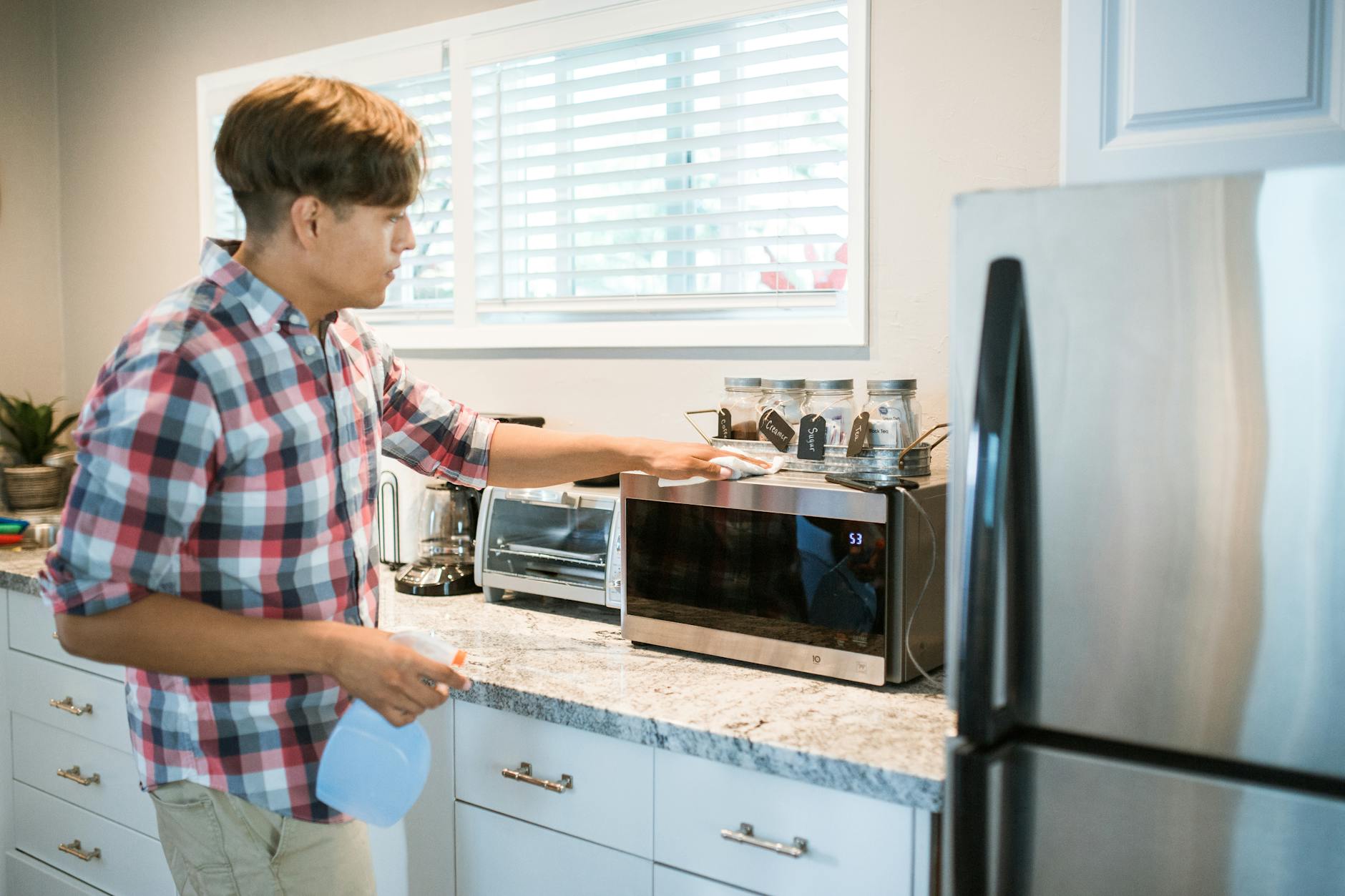
Microwave wattage determines not only how quickly your dinner reheats, but how much electricity you draw from the wall and how evenly your food cooks. Most households overspend on overpowered units, assuming that higher numbers equal better performance, when in fact a 700-watt countertop model often handles 90% of daily tasks more efficiently than a commercial-grade 1250-watt oven. Understanding what microwave wattage you actually need prevents both undercooked frozen dinners and unnecessarily inflated utility bills.
⚡ In a Rush? Key Takeaways
- 700-watt unit handles 90% of daily tasks more efficiently than a 1250-watt oven.
- Higher wattage reduces cooking time but increases instantaneous power draw by 40-60%.
- Solo dwellers and couples require 700 to 800 watts; families need 900 to 1000 watts.
- ✅ Right-size your microwave for your specific needs to save energy and money.
What does microwave wattage actually measure?
Wattage refers to the magnetron’s power output—the actual energy waves penetrating your food—not the electricity pulled from the outlet. A microwave labeled “1000 watts” typically draws 1400 to 1600 watts from your circuit due to inverter inefficiency and cooling fan operation. This distinction matters when calculating running costs or matching the appliance to your kitchen’s 15-amp or 20-amp circuits. The magnetron generates microwave radiation at 2.45 GHz regardless of wattage; higher wattage simply means more photons hitting your food per second, creating faster molecular friction and heat.
Manufacturers test wattage using standardized procedures: heating one liter of water from 20°C to boiling. A 700-watt unit requires approximately 3 minutes and 45 seconds; a 1000-watt unit achieves the same result in roughly 2 minutes and 30 seconds. This 40% speed difference translates directly to your electricity consumption per task, though not necessarily to your annual costs if you adjust cooking times appropriately.
Is higher wattage always better for cooking efficiency?
Higher wattage reduces cooking time but increases instantaneous power draw by 40-60%, costing roughly $0.03 to $0.05 more per 10-minute session at average US electricity rates of $0.16 per kWh. For reheating yesterday’s rice or warming a cup of tea, a 700-watt microwave completes the task in 90 seconds versus 60 seconds in a 1200-watt unit—a negligible time difference that costs significantly less in kilowatt-hours over a year of daily use.
However, higher wattage becomes essential when cooking dense frozen proteins or heating large ceramic vessels. A 700-watt oven struggles to penetrate the thermal mass of a frozen lasagna, resulting in hot edges and frozen centers that require stirring and extended cooking time—potentially using more total energy than a 1000-watt unit that heats evenly in one cycle. The efficiency question hinges on your specific container sizes and food density, not merely the numbers on the control panel.
What wattage do you need for different household sizes?
- Solo dwellers and couples: 700 to 800 watts
- Families of three to four: 900 to 1000 watts
- Large families or commercial use: 1100 to 1250 watts
Units in these ranges typically cost $0.08 to $0.12, $0.10 to $0.15, and $0.18 to $0.22 per 10-minute usage period, respectively.
How much does running different wattages actually cost?
| Wattage | Annual kWh | Annual Cost ($) |
|---|---|---|
| 700 | 43 | 6.88 |
| 1000 | 61 | 9.76 |
Calculating true operating costs requires accounting for both magnetron output and standby power draw. Standby power— the clock and control panel—adds 2 to 6 watts constantly, costing $1.75 to $5.25 annually regardless of cooking wattage. When purchasing, look for units with physical on/off switches or consider unplugging the microwave overnight to eliminate this phantom load.
Can you compensate for lower wattage with technique?
Yes, with adjusted expectations and proper vessel selection. Lower wattage requires 30% longer cooking times for most tasks, but this gentler heating often produces superior results for delicate proteins like fish or eggs that seize and toughen under high-power radiation. Covering food with microwave-safe lids or damp paper towels traps steam, reducing the required cooking time by 15-20% and compensating partially for lower magnetron output.
Container geometry matters more than magnetron power. Wide, shallow dishes expose more surface area to microwave distribution than tall, narrow mugs. Strategic stirring halfway through the cycle—standard practice regardless of wattage—eliminates hot spots more effectively than purchasing excess power you rarely utilize.
For defrosting, lower wattage actually proves superior. The 30-50% power settings on high-wattage ovens simply cycle the magnetron on and off, pulsing full power in bursts that partially cook meat edges while the center remains frozen. A true 700-watt continuous output defrosts more evenly without the texture-damaging hot spots created by pulsed high-wattage cycles.
What microwave features matter more than raw wattage?
Inverter technology, turntable diameter, flatbed options, sensor cooking, and physical footprint all impact efficiency and usability more than raw wattage.
📊 Efficiency Verdict
Right-sizing your microwave to your specific needs saves up to $26 annually and reduces energy waste.
Verdict: right-sizing your microwave
Purchase 700-800 watts for solo use and primary reheating; 900-1000 watts for family cooking and frozen meal preparation; 1100+ watts only if you regularly heat large vessels or cook dense frozen proteins from raw. Anything above your actual usage pattern wastes electricity on standby and encourages habitually running half-empty ovens, which draws the same power regardless of load size. The most efficient microwave is the one sized precisely for your plate dimensions and cooking frequency, not the one with the largest number printed on the control panel.