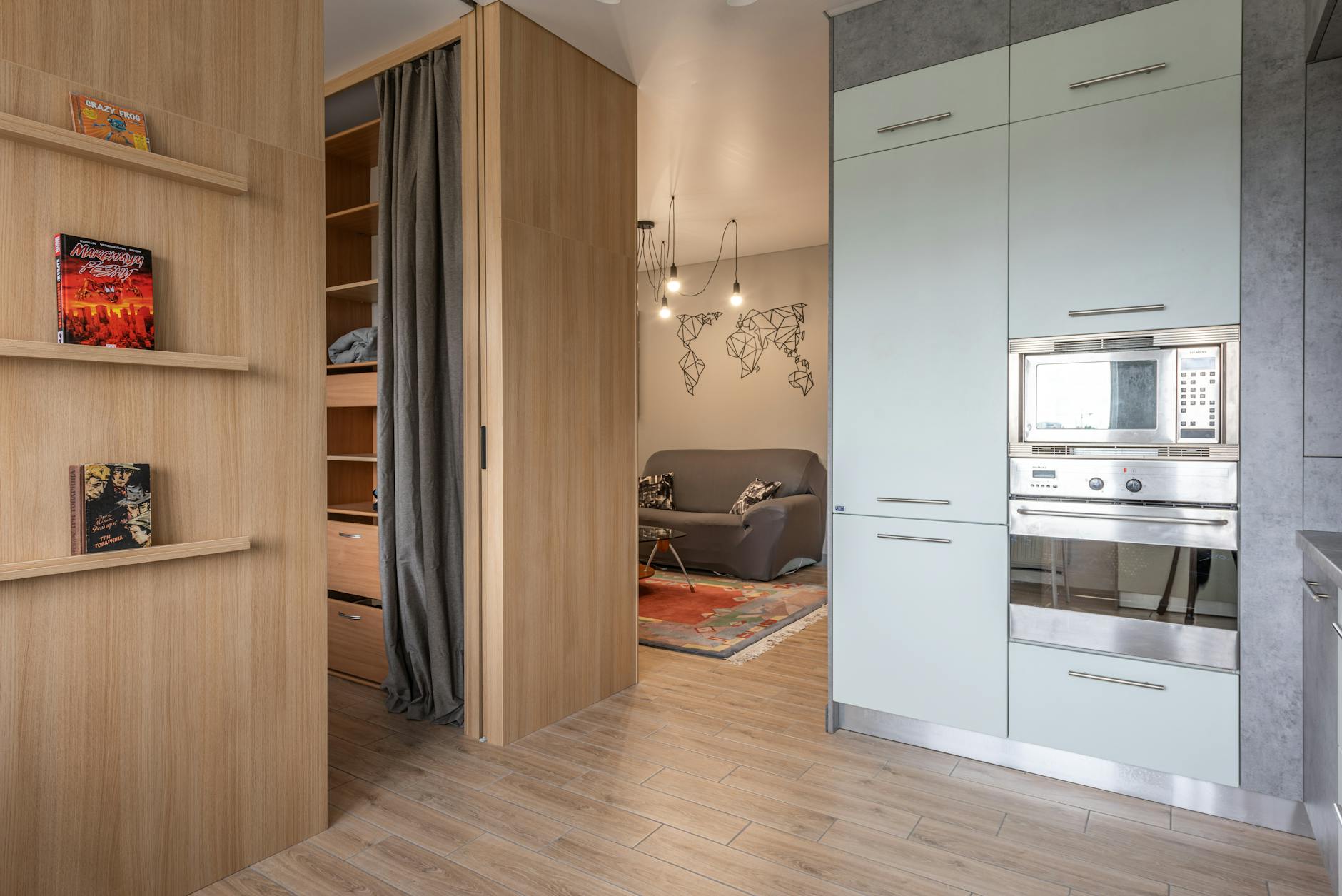
Does this small apartment storage ideas guide apply to studios and one-bedrooms equally?
Studios gain 35% more usable volume per dollar on vertical systems than one-bedrooms, due to higher wall-to-floor ratios and fewer existing closets.
Studio layouts present a unique advantage: uninterrupted wall planes. Without door swings and hallway transitions breaking the vertical surfaces, a 400-square-foot studio often offers more linear feet of usable wall space than a 600-square-foot one-bedroom. This geometry favors continuous shelving systems that can extend from floor to ceiling without navigating around bedroom entrances.
However, the absence of closet doors in studios means any storage solution remains visually present. In one-bedrooms, you can utilize the back of bedroom doors for less aesthetically critical storage, reserving prime visual real estate in living areas for curated displays. The cost implication is immediate: studio dwellers typically spend 20-30% more on attractive containment systems—woven bins, lidded baskets, uniform boxes—to maintain visual coherence in open-concept spaces.
How do you calculate the true cost of storage per cubic foot?
Quality shelving costs $3-4 per cubic foot upfront versus $1.50-2.00 monthly for off-site units, making apartment solutions profitable after three months.
To apply this calculation, measure the interior dimensions of any potential storage unit, subtracting the space occupied by frames, brackets, or housing. A standard six-shelf unit measuring 36 inches wide by 12 inches deep by 72 inches high theoretically offers 18 cubic feet, but the reality after accounting for housing thickness and practical accessibility yields approximately 14 cubic feet of usable capacity. At a retail price of $85, this yields $6.07 per cubic foot.
Compare this to a 5×5 foot climate-controlled storage unit at $65 monthly, offering 200 cubic feet but requiring transportation costs and time expenditure. The break-even mathematics favor in-apartment solutions after approximately 2.5 years, but the daily convenience of accessing your belongings without driving provides additional unquantified value. When budgeting your storage investments, factor in the $25-40 hourly value of your time spent retrieving off-site items.
Which vertical spaces offer the highest return in rental units?
The 18-inch clearance above door frames and 12-inch gap below ceilings provide 45-65 cubic feet per room, accessible with $30-60 tension-rod systems that leave zero wall damage.
The header space above standard 80-inch doors remains chronically underutilized. Installing a simple 12-inch deep shelf along this perimeter requires only adhesive mounting strips rated for 40 pounds per pair. At $45 in materials per room, this crown storage captures seasonal items—luggage, winter bedding, archive boxes—that would otherwise consume $150+ annually in external storage fees.
Ceiling-mounted systems represent the next frontier. Industrial-grade tension rods spanning window alcoves can suspend hanging platforms for lightweight items, effectively creating 20-30 cubic feet of overhead storage per bay. The critical specification is ensuring rods are rated for triple the anticipated load, and never suspending storage above sleeping areas regardless of the hardware’s stated capacity.
Are tension-based systems cheaper than drilled shelving over a lease cycle?
Tension rods and adhesive systems cost $15-45 per linear foot with zero installation fees, compared to $80-120 for drilled units plus $150-200 in potential spackle and paint charges upon move-out.
The economics of damage-free mounting have shifted dramatically with advances in adhesive technology. Modern heavy-duty strips support 16 pounds per pair on painted drywall, sufficient for floating shelves holding books or display objects. For clothing and linen storage, Greta recommends heavy-duty tension rods rated for 40 pounds, installed between sidewalls in alcoves to create instant closets without penetrating plaster.
The depreciation factor favors this approach in short-term leases under 18 months. Drilled shelving requires you to either abandon the hardware or restore walls to original condition using joint compound ($8), primer ($15), and matched paint ($25-40), plus four to six hours of labor. Tension systems travel with you, offering continuity across three to four apartments before the rubber gaskets require replacement at $3-5 per rod.
How much volume exists under typical rental beds?
A queen platform conceals 42 cubic feet—equivalent to a $700 annual storage unit—accessible with $90 rolling drawers or $25 bins that maintain mattress warranty compliance.
Standard bed frames offer 11 inches of clearance, but mattress warranties typically require 2-3 inches of breathing space to prevent moisture accumulation and mold. This leaves 8-9 inches for storage—sufficient for vacuum-sealed textiles, out-of-season footwear in lidded containers, or shallow document boxes.
Investing in purpose-built under-bed systems with integrated casters and dust covers transforms this dead zone into functional archive space. Greta recommends polypropylene under-bed containers with reinforced corners that maintain their geometry for 5-7 years and wipe clean with vinegar solution. Avoid cardboard; the lack of structural integrity leads to collapse within six months, and the material attracts silverfish and carpet beetles.
What is the realistic lifespan of budget versus mid-tier storage furniture?
Particleboard units under $80 sag at 18 months, while steel-frame systems at $180-220 last 8-10 years, costing $1.50-2.00 versus $4.40+ annually.
The honeycomb construction of budget shelving crumbles when exposed to humidity fluctuations common in ground-floor apartments. Once the laminate facing chips at the corners, moisture ingress accelerates, causing visible bowing at the 14-to-20-month mark. At this point, the unit becomes both unsightly and hazardous, prone to catastrophic failure when loaded with books or kitchenware.
Steel modular systems, while requiring higher initial outlay, distribute weight across welded frames rather than cam-locked dowels. Look for powder-coated finishes rather than painted steel; the former resists chipping when bins scrape against uprights. Over a decade, the mid-tier option costs approximately $20 annually versus $53 for replacing budget units every two years.
Where should storage never be installed in a leased apartment?
Blocking HVAC returns reduces efficiency by 15-20% and triggers lease violations, while egress path obstruction risks $250-500 immediate removal fees and liability for blocked fire exits.
The intake vents, usually located on walls near thermostats, require 12-18 inches of clear space to function. Installing bookshelves or stacking bins against these vents forces the HVAC system to labor through longer cycles, increasing electricity costs by $15-25 monthly and potentially damaging the compressor. Landlords increasingly photograph these violations during inspections and deduct remediation costs from deposits.
Fire egress paths—defined as the route from any point in the apartment to the exit door—must remain 36 inches wide per international building code, which most leases incorporate by reference. A storage bench in a narrow hallway or a bicycle rack in a studio’s entry path constitutes a violation. Understanding these restrictions before installing heavy systems prevents expensive disassembly orders.
Do multi-functional furniture pieces justify their higher initial cost?
Storage ottomans cost 50-70% more than standard pieces but eliminate separate storage purchases, breaking even at month 16-20 while saving 8-12 square feet.
A standard coffee table occupies approximately 9 square feet of floor space while providing only surface utility. A lift-top storage model offers 8-10 cubic feet of interior capacity for linens, board games, or office supplies, eliminating the need for a secondary sideboard or shelving unit. At $320 versus $180 for a basic table, the premium seems steep until you calculate the $140-200 cost of the separate storage it replaces.
Similarly, storage beds with integrated drawers eliminate the need for dressers in truly constrained spaces. The drawers operate on metal roller slides rather than wooden channels, maintaining smooth function past the five-year mark when particleboard drawers typically jam or detach. When selecting proportionate furniture for tight quarters, prioritize pieces that perform double duty to minimize the visual clutter of multiple single-purpose items.
Optimizing a small apartment transcends aesthetic organization; it constitutes a financial strategy against the ongoing costs of external storage and premature furniture replacement. By calculating cost-per-cubic-foot, respecting the lifecycle of materials, and selecting systems that migrate between rentals, you create a portable infrastructure of efficiency. The goal is not to fill every corner, but to ensure that every item retained earns its place through utility, and that the containers serving them do not erode your security deposit or your monthly budget.