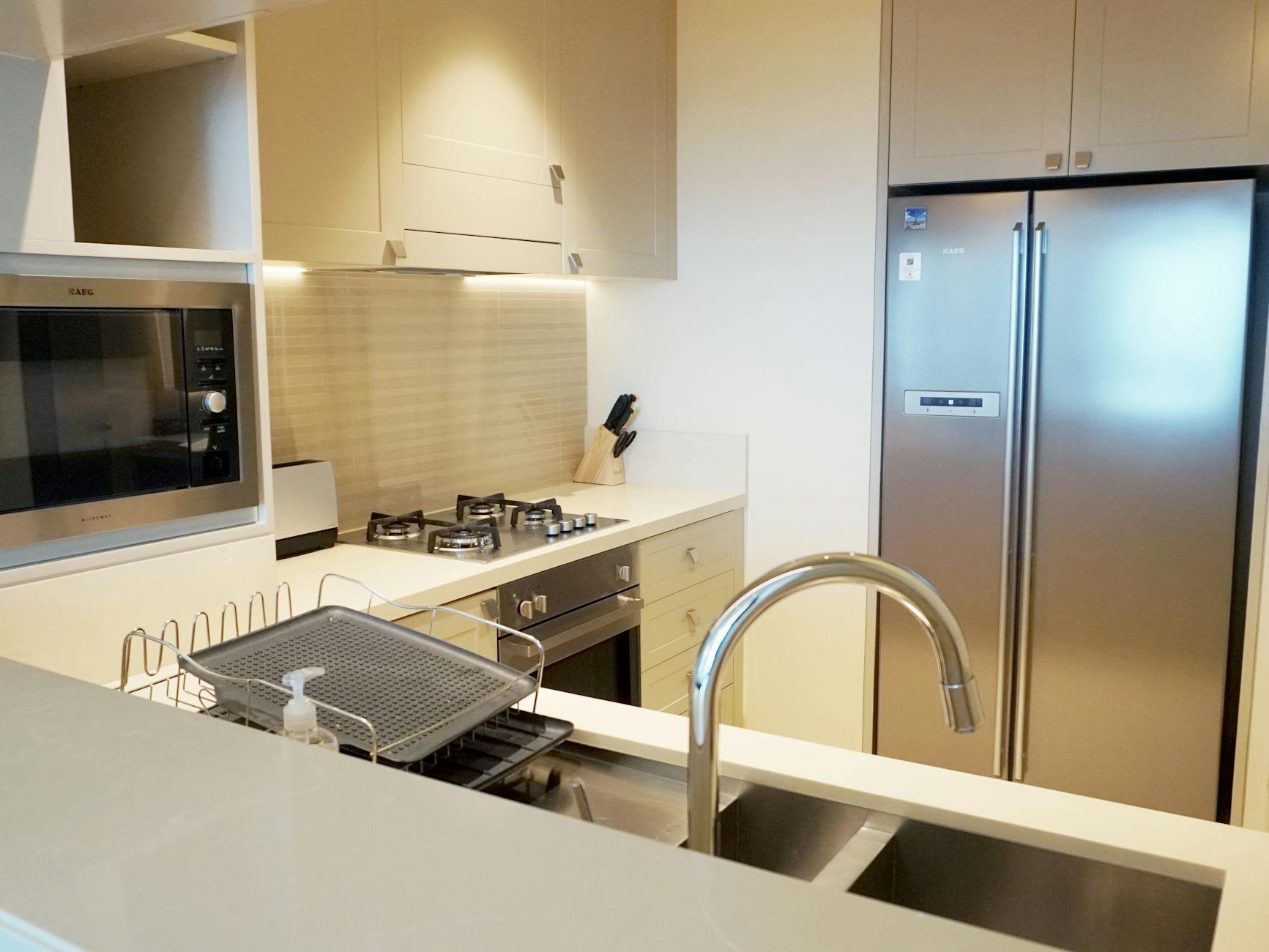
Feeding five or six people requires a refrigeration strategy that extends beyond cubic capacity. The wrong configuration inflates your electricity bill through unnecessary compressor cycles, while an underpowered unit forces expensive mid-week convenience shops. Over the past decade, appliance efficiency has shifted dramatically; the retirement of the old A+++ system in favour of the simplified A–G scale means that ostensibly similar models can vary by £70 in annual running costs. This guide examines how to match litre capacity to household headcount, whether the American aesthetic justifies its energy premium, and which features genuinely reduce long-term ownership costs rather than merely adding purchase price.
⚡ In a Rush? Key Takeaways
- Modern 400-litre combi units cost £75–£90 annually.
- Larger 500–600 litre units cost £105–£120 annually.
- Older F-rated models can exceed £180 annually.
- ✅ Choose a model with rapid-recovery insulation and inverter compressor for energy efficiency.
Expect £60–£110 annually for a modern family-sized unit rated C or above, based on 30p/kWh. Older F-rated models can exceed £180.
With domestic electricity hovering near 30p per kWh, a modern 400-litre combi unit with a C rating consumes approximately 250–300 kWh annually, translating to £75–£90. However, families who maintain stockpiles of batch-cooked meals or bulk-purchased meat require larger capacities. A 500–600 litre side-by-side or tall unit typically draws 350–400 kWh, placing annual costs between £105 and £120.
The critical variable is not merely the energy label but the usage pattern. Each time the door opens, the compressor compensates for temperature loss. In a household with children accessing the appliance twenty times daily versus a couple opening it six times, the compressor runs proportionally harder. Therefore, selecting a model with rapid-recovery insulation—indicated by a sub-24-hour safe-food time during power cuts—minimises these transient losses. Additionally, models with inverter compressors adjust speed rather than cycling on and off, reducing energy spikes by approximately 20% compared to conventional motors. When calculating total cost of ownership, multiply the quoted annual kWh by your current tariff, then project across eight to ten years. A £200 premium for a B-rated model over a D-rated equivalent typically pays for itself within thirty-six months in a high-usage household. You can verify specific models using an appliance running cost calculator before purchasing.
How many litres of refrigeration space does a household of five actually require?
Allow 100–120 litres of fridge space and 50–70 litres of freezer space per adult; a family of five needs 550–700 litres total to accommodate a weekly shop without crowding.
Crowding is the enemy of efficiency. When air cannot circulate between containers, cold pockets form, prompting the thermostat to demand unnecessary cooling. For a family consuming seventeen to twenty meals at home weekly, the refrigerator compartment must accommodate not merely ingredients but leftovers in lidded containers. A 400-litre total capacity—common in standard 60cm-wide units—forces either daily shopping or precarious stacking that blocks vents.
The freezer allocation proves equally critical. Bulk purchasing proteins when discounted requires roughly 100 litres dedicated to meat alone for a fortnight’s supply. Therefore, examine the drawer configuration as diligently as the litre count. Deep drawers prevent the archaeological excavation that raises internal temperatures; five shallow baskets lose cold air faster than three deep compartments when accessed. If your kitchen cannot accommodate a 70cm-wide unit, consider pairing a standard 60cm fridge with a separate chest freezer in a utility room. This arrangement often consumes less energy than a single American-style unit because chest freezers retain cold air when opened, unlike upright configurations. Our guide to kitchen workflow systems details how to map storage zones for high-throughput households.
Is a 70/30 split more efficient than 50/50 for family meal planning?
Yes. The refrigeration-to-volume ratio in a 70/30 tall unit typically consumes 15–20% less energy than a 50/50 combi of identical external dimensions.
The mathematics of thermal mass explain this discrepancy. Refrigeration compartments maintain temperatures between 1°C and 5°C, a narrower delta than freezer sections, requiring less energy to restore equilibrium after door openings. By allocating 70% of the internal volume to the less energy-intensive refrigerator compartment, the appliance reduces its overall thermal burden.
For families who batch-cook three evenings weekly, the 30% freezer allocation—typically 120–140 litres in a 400-litre unit—suffices for two weeks of pre-portioned meals. The remaining 280 litres accommodates fresh produce, dairy, and chilled proteins without the Tetris-like inefficiency of a 50/50 split, where fresh vegetables often occupy freezer space due to crowding, or vice versa.
Furthermore, 70/30 units typically employ single-compressor systems with dual evaporators, whereas some 50/50 models use separate compressors, doubling the potential points of failure and maintenance costs. The vertical layout also suits British kitchen ergonomics; the refrigerator section at eye level reduces the duration of door openings while the lower freezer drawers slide out without requiring the kneeling necessitated by upper-mounted freezers. When assessing your energy efficiency ratings, verify whether the quoted consumption assumes a 70/30 or 50/50 configuration, as this affects real-world costs.
Do American-style side-by-side units waste energy in British kitchens?
Generally yes. Side-by-side models use 10–15% more electricity per litre stored due to greater surface area and upright freezer design.
The architectural appeal of stainless-steel double doors conceals thermodynamic compromise. Side-by-side units expose frozen goods to ambient temperature each time either door opens, whereas separate compartments isolate the freezer’s thermal mass. Additionally, the slim vertical columns inhibit air circulation, requiring fans that consume 40–60 additional kWh annually.
In the typical British kitchen—averaging 13.5 square metres—these units also present spatial inefficiencies. They require 90–100cm width plus ventilation gaps, often dominating the room and restricting layout flexibility. The through-draft from external walls common in Victorian and Edwardian terraces exacerbates energy loss; side-by-side units have significantly more gasket surface area than upright combis, offering more potential points of air ingress.
However, for households exceeding six members, the sheer capacity—often 600 litres plus—may necessitate the format. If choosing this style, select models with individual door alarms and vacation modes that reduce freezer operation to -18°C only, disabling ice makers that consume 10% of the unit’s total energy budget. Consider whether a tall 70cm-wide combi paired with a under-counter freezer might offer similar capacity with superior thermal efficiency, particularly in period properties with limited insulation.
Which energy rating offers the best long-term value for high-usage households?
An A or B rating justifies the £150–£300 purchase premium if you intend to keep the appliance for seven years or more, saving £25–£40 annually.
Since the 2021 rescaling of EU energy labels, the majority of domestic appliances now cluster between D and F, making genuine A and B ratings rare and valuable. For a family opening the doors forty times daily, the inverter technology and vacuum-insulated panels required to achieve these ratings reduce compressor strain significantly.
The calculation hinges on retention period. If you relocate frequently or renovate kitchens every four years, the premium for an A-rated unit may not amortize. However, the average British household retains major appliances for eleven years. Over that decade, a B-rated 500-litre unit consuming 220 kWh annually versus an F-rated equivalent consuming 380 kWh represents a £480 saving at current tariffs—more than enough to cover the initial price differential.
Additionally, high-efficiency models typically employ brushless motors and LED lighting with motion sensors, reducing component failure rates. When evaluating labels, scrutinize the QR code linking to the EPREL database; some manufacturers achieve headline ratings through eco-modes that disable features like rapid chilling, rendering them impractical for large families. Ensure the rating reflects realistic usage patterns including frequent door openings and ambient kitchen temperatures above 20°C.
Does frost-free technology justify its higher purchase price?
Manual defrosting wastes £40–£60 annually in spoiled food and energy; auto-defrost adds £80–£120 to purchase price but pays back within two years.
Ice accumulation acts as an insulator, forcing the compressor to run longer to maintain -18°C. When frost exceeds three millimetres, energy consumption increases by approximately 10%. In a manual-defrost unit used by a large family, this accumulation occurs every four to six months, necessitating a shutdown, removal of contents to cool boxes, and twelve hours of passive melting.
The labour cost alone—if valued at even £15 hourly—exceeds the capital cost difference. Frost-free models circulate dry air to prevent ice formation, though this consumes marginally more energy (5–8%) during normal operation. For families storing sensitive items like ice cream or breast milk, the temperature stability of frost-free systems prevents the partial thawing that degrades texture during manual defrost cycles.
Select models with adaptive defrost that monitors door openings and compressor run-time rather than timed cycles; these reduce unnecessary energy expenditure by defrosting only when sensors indicate frost accumulation, typically extending the interval between cycles by 30% compared to basic timer systems.
Conclusion
Selecting refrigeration for a large household demands arithmetic rather than impulse. Calculate your required litreage based on meal frequency, multiply the annual kWh by your electricity tariff across ten years, and subtract that total from the purchase price to reveal the true cost. Prioritise rapid-recovery insulation and inverter compressors over through-the-door ice dispensers that compromise thermal integrity. The most efficient appliance is the one that fits your kitchen without dictating its layout, allowing the doors to seal fully against draughts. In the current energy market, the gap between an efficient B-rated unit and a middling D-rated one funds a significant portion of your next electricity bill.
📊 Efficiency Verdict
Invest in a B-rated model with rapid-recovery insulation and inverter compressor for the best long-term value in high-usage households.