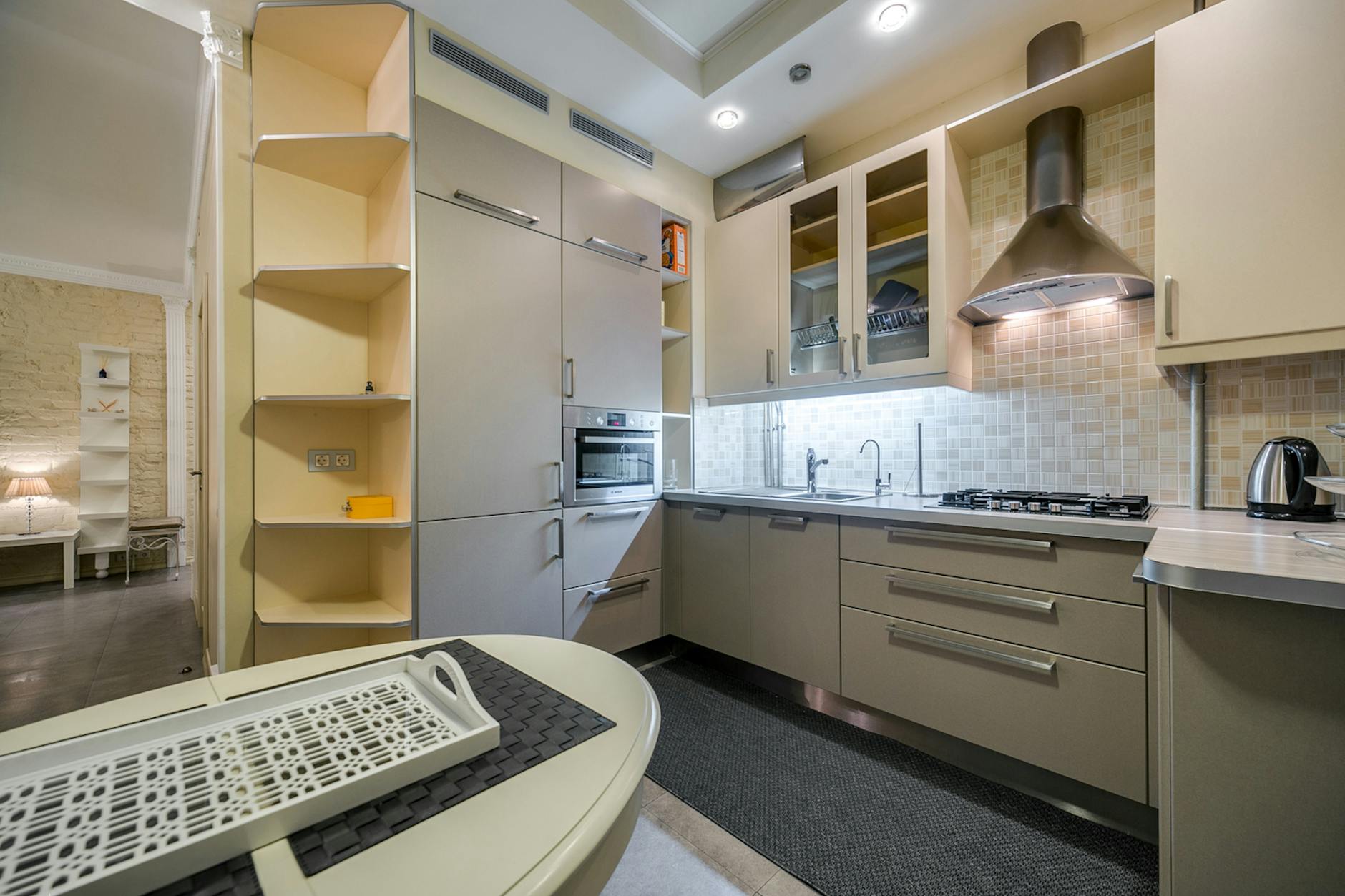
When considering kitchen improvements, under cabinet lighting often falls into the category of aesthetic enhancement rather than functional infrastructure. Yet the choice of fixtures, drivers, and installation methods fundamentally determines whether this addition becomes a silent drain on your household electricity or a genuinely efficient extension of your kitchen workflow systems. This under cabinet lighting efficiency guide examines the actual wattage demands, comparative bulb technologies, and installation approaches that minimize running costs while maintaining the task illumination necessary for safe food preparation.
⚡ In a Rush? Key Takeaways
- Quality LED fixtures consume 6-10 watts per linear foot, compared to 20-25 watts for xenon.
- LEDs deliver 80-100 lumens per watt, while xenon offers only 20-30.
- Hardwired systems save 2-5 watts continuously by eliminating vampire draw from wall adapters.
- ✅ Choose quality LED fixtures with constant-current drivers for long-term efficiency.
How much electricity does under cabinet lighting actually use?
A typical four-foot LED strip system draws 18 watts total. Running four hours nightly costs approximately $8-$12 annually at average U.S. electricity rates.
To calculate your specific expenditure, begin by examining the fixture specifications. Quality LED bar fixtures typically consume 6 to 10 watts per linear foot, while older fluorescent T5 strips draw roughly 9 to 13 watts per foot, and xenon halogens consume a substantial 20 to 25 watts per foot. For a standard six-foot kitchen counter illuminated by three twenty-four-inch LED bars, you are looking at a total connected load of approximately 36 watts.
- LED: 6-10 watts/foot
- Fluorescent T5: 9-13 watts/foot
- Xenon: 20-25 watts/foot
Multiplying this by four hours of daily evening use yields 0.144 kilowatt-hours per day. Over a year, this accumulates to roughly 52.5 kilowatt-hours. At the current national average residential electricity rate of $0.14 per kilowatt-hour, operating these fixtures costs $7.35 annually. Comparable xenon systems would consume approximately 90 watts total, translating to $18.35 annually—nearly triple the LED expenditure. When evaluating LED versus xenon running costs, the annual delta covers the price premium of quality LED fixtures within the first eighteen months of operation.
Is LED always the most efficient choice for under cabinet lighting?
Yes. Quality LED fixtures deliver 80-100 lumens per watt, whereas xenon offers only 20-30. This efficiency gap means LEDs use roughly one-quarter the electricity for identical brightness.
The efficacy advantage becomes particularly pronounced when examining heat generation. Xenon and halogen under cabinet lights operate by heating a filament or gas to incandescence, rendering them essentially small space heaters attached to your cabinetry. In summer months, this thermal load indirectly increases air conditioning costs, a secondary efficiency penalty rarely calculated in initial comparisons. LEDs convert electrical energy directly to photons through electroluminescence, remaining cool enough to touch even after hours of operation.
Fluorescent tubes occupy a middle ground at 50-70 lumens per watt, but their efficiency degrades significantly in cold environments—problematic for pantries or exterior-facing cabinets—and they require warmup time to reach full output. Additionally, fluorescent fixtures contain mercury vapor, complicating disposal and adding hidden environmental costs outside the electrical bill. For pure efficiency, LEDs remain unmatched, though those seeking exceptional color rendering index (CRI) values above 95 for photographic or precise visual work might accept the energy penalty of xenon for its sunlight-like spectrum.
| Option | Key stat | Best for |
|---|---|---|
| LED | 80-100 lumens/watt | General task lighting |
| Xenon | 20-30 lumens/watt | High CRI applications |
| Fluorescent | 50-70 lumens/watt | Cold environments |
What color temperature provides the most efficient task illumination?
3500K-4000K cool white delivers maximum perceived brightness per lumen. Warmer 2700K tones require 15-20% higher wattage to achieve equivalent work surface lux levels.
Color temperature significantly influences perceived brightness efficiency. The human eye, particularly in aging populations, detects short-wavelength blue-white light (4000K-5000K) more acutely than warm yellow light (2700K-3000K) for detailed tasks like chopping vegetables or reading recipes. This photometric sensitivity means you can achieve adequate task illumination at lower absolute lumen outputs—and therefore lower wattage—using neutral white LEDs compared to warm whites.
However, efficiency here must balance against comfort. Above 4500K, the clinical quality of light can feel institutional in residential kitchens, prompting homeowners to compensate by installing additional fixtures or increasing brightness levels, paradoxically increasing consumption. The 3500K to 4000K range offers the optimal compromise, providing the scotopic visual advantage of cooler light while maintaining the welcoming atmosphere appropriate for evening cooking. When selecting fixtures, look for those maintaining 90+ CRI within this temperature range to ensure colors appear natural despite the cooler tone.
Hardwired versus plug-in systems: which saves more energy long term?
Hardwired systems eliminate vampire draw from wall adapters, saving roughly 2-5 watts continuously. This prevents $5-$12 of annual standby electricity waste per cabinet bank.
Plug-in LED kits offer undeniable installation convenience, but their wall-wart transformers draw standby power continuously—often 0.5 to 1 watt even when the lights are switched off. Multiplied across three or four cabinet locations and 8,760 hours annually, this phantom load becomes significant. Hardwired installations utilizing dedicated LED drivers wired to wall switches eliminate this waste entirely; when the circuit breaks, consumption drops to true zero.
Additionally, hardwired systems accommodate phase-cut dimmers compatible with modern LED drivers, allowing wattage reduction during ambient-only usage periods. Plug-in systems rarely support smooth dimming, forcing users to accept full brightness or complete darkness. The installation investment for hardwiring—typically requiring an electrician for one to two hours—pays back through these efficiency gains within three to five years, depending on local labor rates and electricity pricing. For those conducting domestic energy audits, eliminating plug-in lighting transformer loads represents an easy intervention with measurable returns.
How long do quality under cabinet LEDs actually last?
Quality constant-current LEDs maintain 70% brightness for 50,000 hours, equating to seventeen years of evening use. Budget resistive-dropper strips degrade within 8,000 hours.
Lifespan directly impacts lifecycle cost efficiency. L70 ratings—the point at which LEDs depreciate to 70% of initial lumens—vary dramatically based on thermal management and driver quality. Premium fixtures mounted in aluminium channels that dissipate heat into the cabinet framework can achieve the full 50,000-hour rating. Conversely, adhesive-backed LED tape stuck to unfinished wood or laminate surfaces trap thermal energy, accelerating lumen depreciation by 30-40%.
The driver topology matters equally. Constant-current drivers maintain stable wattage and brightness throughout the voltage range, whereas cheap resistive-dropper designs (common in sub-$20 kits) waste energy as heat through resistors and suffer from voltage fluctuation sensitivity. These budget systems often exhibit flicker invisible to the naked eye but measurable by power meters, indicating wasted electrical cycles. When amortizing fixture costs over operational lifespan, a $60 quality LED system costs approximately $0.12 per month including electricity, while a $15 budget kit requiring replacement every two years costs $0.78 per month—over six times the long-term expense.
Can strategic task lighting reduce your total kitchen electricity consumption?
Properly zoned task lighting allows reducing overhead ambient lighting by 40-60% during food prep, yielding net annual savings of $25-$50 even after accounting for new fixture draw.
The highest efficiency gains emerge not from the under cabinet fixtures themselves but from their interaction with overhead ambient lighting. Kitchens traditionally rely on recessed can lights or surface-mounted fixtures consuming 60-200 watts total to provide sufficient countertop illumination. By installing focused 3000-4000 lumen task lighting at the work surface, you can comfortably dim or extinguish overhead fixtures during detailed cooking periods while maintaining superior visibility where actual work occurs.
This layered lighting approach—ambient, task, and accent—allows psychological brightness to remain high while electrical load drops significantly. The human eye adapts to local brightness; a well-lit counter against a dimmed background feels adequately illuminated, whereas the reverse (dim counters, bright overheads) creates frustrating shadows. Implementing separate switch controls for task zones enables this efficiency strategy. Over a decade, these behavioral optimizations compound the hardware efficiency gains, potentially offsetting the embodied energy of the fixtures themselves.
What hidden inefficiencies plague budget under cabinet kits?
Inexpensive LED tape kits often use resistive current limiting rather than proper drivers, converting 30% of input energy to heat. They also emit uneven illumination with color shift within months.
The marketplace proliferation of $10-20 LED tape kits creates a false economy. These systems typically operate at 12Vdc via linear regulators or simple resistors rather than switching-mode power supplies. The resistive elements dissipate approximately 25-35% of input energy as heat before reaching the LEDs, destroying the technology’s fundamental efficiency advantage. Furthermore, the copper traces on economy-grade flexible printed circuit boards carry insufficient current for consistent voltage along the length of the strip, resulting in visible dimming toward the end of runs and color temperature shifts as current varies.
Genuine efficiency requires proper constant-current drivers and aluminium-channel mounting. I earn a small commission when you purchase through Greta’s recommendations, which currently include high-efficacy LED bars from established architectural lighting manufacturers like WAC Lighting or Kichler, whose constant-current drivers exceed 90% efficiency and maintain consistent 3000K color temperature throughout their rated lifespan. Avoid the temptation of multi-color RGB strips for primary task lighting; the additional control circuitry and suboptimal diode configurations sacrifice 15-20% efficacy compared to dedicated white-light fixtures.
Ultimately, under cabinet lighting efficiency depends on holistic system design—selecting appropriate color temperature, ensuring proper thermal management, and installing switching that eliminates standby consumption. The initial hardware investment in quality components returns dividends through reduced kilowatt-hour consumption and elimination of replacement labor for a decade or more.
📊 Efficiency Verdict
Quality LED fixtures with constant-current drivers and proper thermal management offer the most efficient under cabinet lighting, with a lifecycle cost six times lower than budget alternatives.