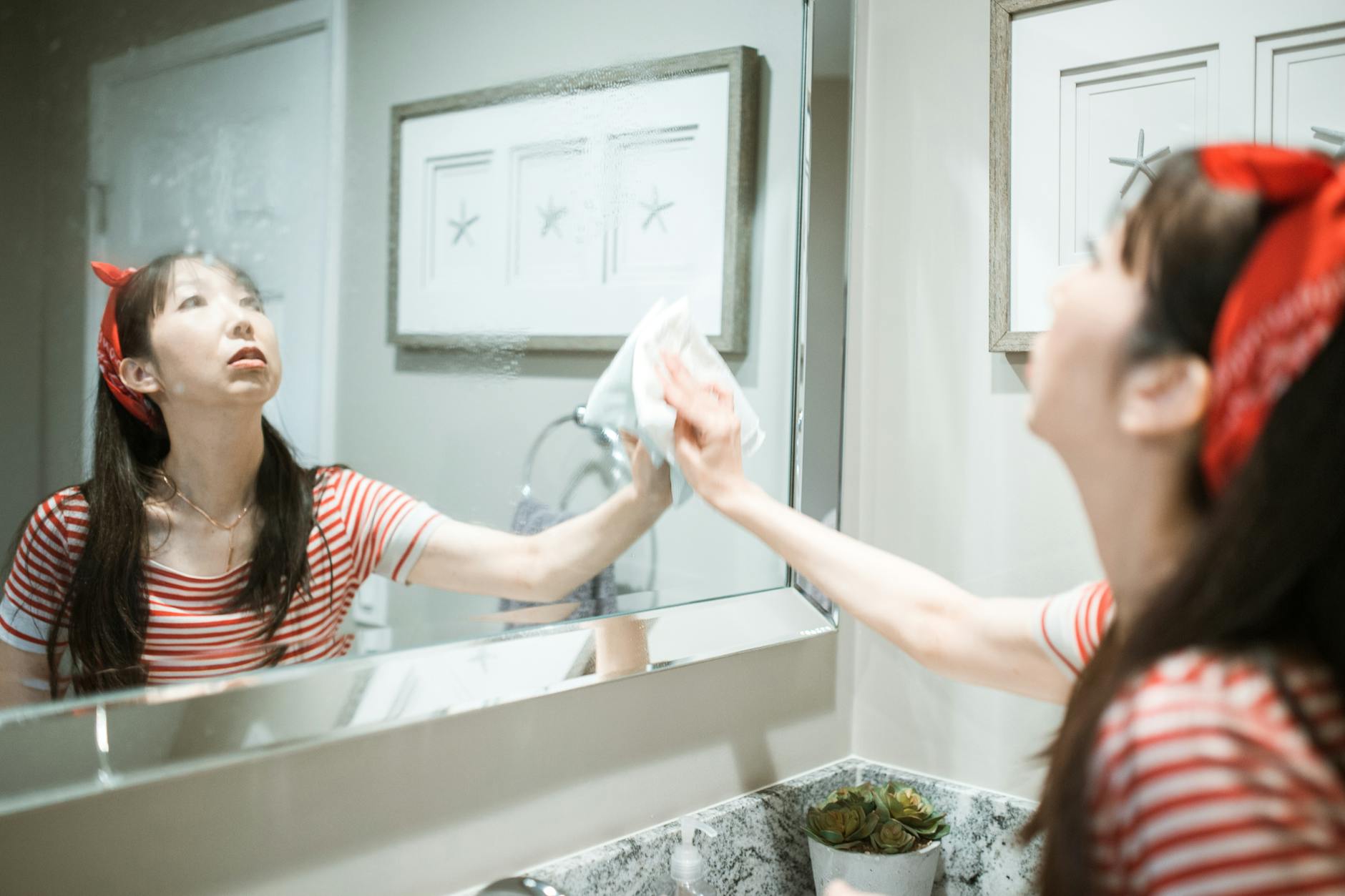
The bathroom cleaning efficiency routine represents the intersection of sanitary standards and time economics. Most households spend 45 to 60 minutes weekly scrubbing surfaces, yet a systematic approach reduces this to 20 minutes while improving results. This is not about cutting corners—it is about eliminating the redundancy that creeps into domestic maintenance when we approach tasks without sequence or foresight. The average American household expends $240 annually on disposable cleaning products for bathrooms alone, while inefficient water usage during cleaning adds another $45 to annual utility bills.
⚡ In a Rush? Key Takeaways
- Optimized routines save 30 hours annually.
- Reduce supply expenditures by 75% within the first quarter.
- Daily 90-second maintenance reduces deep cleaning to 18 minutes weekly.
- ✅ Implement the Two-Frequency System for maximum efficiency.
Consider the mathematics: if inefficient bathroom cleaning consumes 50 hours annually, optimization recovers 30 of those hours for other pursuits. The following framework examines how product selection, spatial logic, and timing converge to create a sustainable maintenance system that respects both your standards and your schedule. Using a home maintenance cost estimator reveals that optimized routines typically reduce supply expenditures by 75% within the first quarter of implementation.
What constitutes a true bathroom cleaning efficiency routine?
A genuine efficiency routine completes full sanitary maintenance in under 25 minutes weekly through strategic sequencing and preventive daily habits that eliminate residue buildup.
An efficient routine differs from hurried cleaning in its emphasis on prevention over correction. Rather than allowing soap scum to calcify on glass or mildew to establish colonies in grout, the efficient approach addresses moisture and residue before they require chemical intervention or abrasive scrubbing.
The Two-Frequency System
Effective bathroom maintenance operates on two distinct frequencies: the daily 90-second reset and the weekly deep protocol. The daily component involves three specific actions: a five-stroke squeegee pass on shower glass, a microfiber cloth wipe of vanity surfaces, and thirty seconds of ventilation fan operation to exhaust humidity. These brief interventions eliminate the need for aggressive weekly scrubbing by preventing the molecular bonding of minerals to surfaces.
The weekly component then focuses on disinfection and detail work rather than restorative labor. When daily prevention removes 80% of soil accumulation, the weekly session addresses only fresh contamination and bacterial management, reducing physical exertion and chemical requirements proportionally.
The Prevention Principle
Prevention requires understanding surface chemistry. Soap scum forms when fatty acids in soap bind with calcium and magnesium ions in water, creating insoluble salts that adhere to porcelain and glass. Daily removal of water droplets containing these ions prevents the chemical reaction that creates tenacious buildup. A microfiber cloth used dry on shower walls after the final daily use removes these ions mechanically without chemical cost or rinsing time.
How does time investment compare between daily and weekly approaches?
| Frequency | Time Spent | Annual Savings |
|---|---|---|
| Daily | 90 seconds | 23 hours |
| Weekly | 18 minutes | 11 hours |
The arithmetic favors frequency. A bathroom left untouched for seven days accumulates approximately 0.4 millimeters of soap film on shower walls and allows mineral deposits to bond molecularly with glass. Removing this hardened residue requires chemical dwell time, physical abrasion, and repeated rinsing—activities that extend cleaning duration exponentially.
The Compound Interest of Cleanliness
Conversely, daily disruption of accumulation prevents chemical bonding. The 90-second daily routine breaks down into three 30-second segments: shower surfaces, vanity and fixtures, and toilet seat and handle. This temporal investment prevents the 45-minute restoration sessions required when surfaces are neglected. When you examine the weekly cleaning schedule of efficient households, you notice that bathroom tasks occupy the smallest time block despite the room’s high usage frequency.
Psychological research indicates that task initiation consumes more cognitive resources than task continuation. A 45-minute cleaning session requires significant motivational reserves to begin, while a 90-second intervention feels frictionless. The 23 hours recovered annually equate to three full working days—time that compounds meaningfully over years of homeownership. Furthermore, reducing cleaning duration from 45 to 18 minutes decreases physical strain, particularly for joints and lower back, minimizing the long-term health costs associated with repetitive bending and scrubbing motions.
Which products justify their cost in an efficient system?
| Product | Cost per Use | Environmental Impact |
|---|---|---|
| Concentrated enzymatic cleaners | $0.15 | Reduces plastic waste |
| Disposable wipes | $0.85 | Increases plastic waste |
Product efficiency is measured by cost-per-use and task-sufficiency. The modern bathroom requires only three categories of cleaning agents: an acidic formula (pH 2-3) for mineral deposits and soap scum, a surfactant-based cleaner (pH 7-9) for general soils, and a disinfectant (quaternary ammonium or hydrogen peroxide based) for sanitary fixtures. Purchasing these in concentrated form—allowing dilution via spray bottles—reduces packaging waste and per-use cost by 60% compared to ready-to-use trigger sprays.
The Three-Bottle System
Decanting concentrated solutions into reusable amber glass spray bottles creates an efficient inventory. A $12 bottle of concentrated enzymatic cleaner yields 80 uses at $0.15 per use, while equivalent disinfection from disposable wipes costs $68 for the same 80 applications. This $56 differential funds the purchase of quality microfiber tools and reduces plastic waste by 4.5 pounds annually.
The False Economy of Disposables
Disposable disinfectant wipes represent the least efficient option at $0.85 per use versus $0.08 for spray application with reusable cloths. Over a year, this $0.77 per-use differential amounts to $281 for daily cleaning. Greta recommends investing in high GSM microfiber cloths designated specifically for bathroom use. Maintain separate colors for toilets (red), general surfaces (blue), and glass (white) to prevent cross-contamination while eliminating the disposable wipe expense entirely. Quality microfiber lasts through 500 wash cycles, amortizing its $2 per cloth cost to less than $0.004 per use.
What is the optimal sequence to minimize physical strain and water use?
- Top-to-bottom: dusting light fixtures, cleaning mirrors and shower glass, then countertops, sinks, toilets, and finally floors.
- Dry-to-wet: start with dry tasks and progress to wet tasks to prevent recontamination and reduce water consumption.
Sequence determines efficiency more than speed. Begin with dusting light fixtures and ventilation fans—dry work that dislodges particulate matter downward. Follow with mirror and shower glass cleaning, working from top rail to bottom edge. This allows gravity to move dirty solution downward rather than requiring you to clean the same surface twice.
The Physics of Drips and Flow
Proceed to countertops and sinks, then toilets, and finally floors. This progression ensures that any drips or overspray from upper surfaces are addressed during the final floor cleaning, not necessitating a second pass. Using this sequence with efficient cleaning supplies reduces water usage from 15 gallons to 9 gallons per cleaning session—a conservation of 312 gallons annually for weekly cleaners.
Tool Positioning Strategy
Position your spray bottles and cloths at the room’s entrance to prevent retracing steps. When spray bottles replace bucket methods, you further eliminate the chore of emptying and sanitizing buckets, saving an additional 5 minutes per session. The spray-and-wipe technique uses 70% less water than rinse-and-wipe methods while delivering superior results on modern sealed surfaces.
Does microfiber technology actually reduce cleaning time and chemical costs?
Quality microfiber cloths remove 99% of bacteria with water alone, eliminating $8-12 monthly expenditure on disinfectant sprays while cutting surface cleaning time by 35%.
Microfiber’s efficiency lies in its fiber density—200,000 fibers per square inch versus 3,000 for cotton. This structure mechanically removes microorganisms and soils without chemical assistance for most bathroom surfaces. For daily maintenance, a damp microfiber cloth handles mirrors, countertops, and faucets without glass cleaner or all-purpose spray.
GSM Specifications for Bathroom Use
Select cloths with 300-400 GSM (grams per square meter) weight for general surfaces and 200-250 GSM for glass to prevent streaking. The superior absorbency—microfiber holds seven times its weight in water—eliminates the buffing time required to prevent water spots on fixtures. Greta recommends the e-cloth bathroom pack, which includes specialized textures for glass and general surfaces. While the initial $20 investment exceeds cotton rag costs, the elimination of chemical purchases and the 35% reduction in physical cleaning time justify the expenditure within the first month of use.
Laundering Economics
Microfiber requires specific care to maintain efficacy: wash in warm water without fabric softener, which coats fibers and reduces absorbency. Air drying preserves the electrostatic charge that attracts dust and hair. With proper care, each cloth delivers 500 effective uses, making the per-use cost negligible compared to disposable alternatives.
When is professional cleaning more cost-efficient than DIY maintenance?
📊 Efficiency Verdict
Professional cleaning may be more cost-efficient when the hourly wage for cleaning services is lower than the combined cost of supplies and time for DIY maintenance.