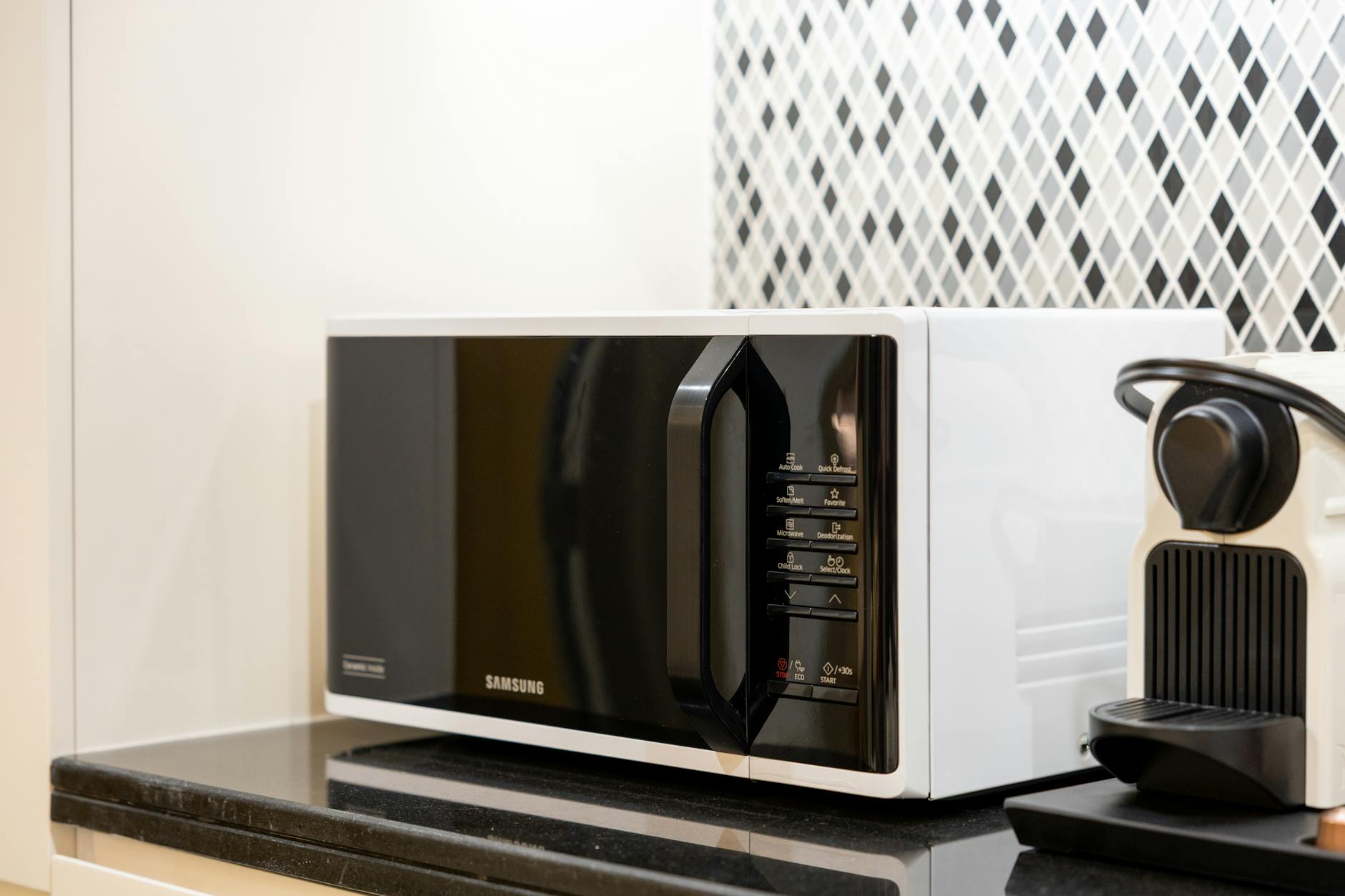
The real-world difference between a 900 and 1000 watt microwave is roughly 10% faster cooking time — translating to about 30 extra seconds on a typical frozen meal — while annual running costs diverge by less than $1, making wattage range and inverter technology far more decisive than that single 100-watt gap.
⚡ In a Rush? Key Takeaways
- Cooking time decreases roughly 10% for every 100-watt increase in microwave wattage.
- A 900 watt and 1000 watt microwave cost virtually the same to run — annual difference under $1 at typical US electricity rates.
- Higher wattage increases instantaneous power draw by 40–60%, but shorter cook times keep total energy consumption nearly equal.
- Most households find 800–900W offers the optimal balance of speed, evenness, and cost for daily cooking.
- ✅ Inverter technology and turntable quality matter more than the gap between 900 and 1000 watts.
What does microwave wattage actually measure?
Wattage indicates the magnetron’s cooking power — the rate at which it converts electricity into microwave energy and delivers it to your food. Higher numbers mean faster cooking, not necessarily better efficiency or build quality. The magnetron generates microwave radiation at 2.45 GHz regardless of wattage; a higher watt rating simply means more energy hits your food per second, creating faster molecular friction and heat.
The wattage rating stamped on the serial plate represents output power, not electrical draw. A microwave oven labeled “1000 watts” delivers 1000 watts of cooking energy to your food, but typically pulls 1400–1600 watts from your outlet to power the magnetron, cooling fan, turntable motor, and control board simultaneously. This distinction matters when calculating circuit load — particularly in older kitchens with 15-amp circuits — or when using an appliance running cost calculator to estimate monthly expenses.
Manufacturers standardise wattage testing by heating one litre of water from 20°C to boiling. A 700 watt unit takes roughly 3 minutes 45 seconds; a 1000 watt unit achieves the same result in about 2 minutes 30 seconds. That 40% speed difference translates directly to per-task cooking time, though not necessarily to annual costs if you adjust times appropriately.
Is there actually a big difference between 900 and 1000 watts?
For everyday use a microwave, the honest answer is: barely. That 100-watt gap delivers approximately 30 fewer seconds on a standard frozen entrée and costs fractions of a cent more per session. Where the difference becomes perceptible is with dense, cold-centred foods — a thick frozen lasagna or a large potato — where the marginally higher power level of a 1000 watt model edges ahead on penetration depth and evenness.
What matters far more than this narrow gap is whether either microwave oven uses inverter technology. Conventional microwaves at any wattage achieve lower power levels by cycling the magnetron fully on and fully off in pulses — essentially blasting your food at full wattage in bursts, which creates the uneven hot spots and rubbery textures familiar from reheating leftovers. Inverter models deliver genuinely continuous, reduced power, producing dramatically more even results regardless of whether you’re working with 900 watts or 1000 watts. If both a 900W and 1000W model are on your shortlist and one has inverter technology, choose that one every time.
How much does microwave power affect cooking time?
Cooking time decreases roughly 10% for every 100-watt increase across the practical residential range. A 1000W microwave completes tasks in approximately 70% of the time required by a 700W model, though energy consumed per meal remains comparable because the higher the wattage, the shorter the runtime.
- Defrosting a pound of ground beef takes eleven minutes at 600 watts, eight minutes at 800 watts, and six minutes at 1100 watts.
- Reheating a plate of leftovers runs roughly 3.5 minutes at 700 watts versus 2.5 minutes at 1000 watts.
- The efficiency curve plateaus above 1100 watts for most tasks, as food chemistry limits how quickly molecules absorb energy without uneven heating or texture degradation.
One nuance worth noting: for defrosting specifically, lower continuous wattage can actually outperform pulsed high-wattage cycles. A genuine 700 watt steady output defrosts more evenly than a 1000W conventional oven cycling on and off at 50% power level, because pulsed bursts partially cook meat edges while the centre stays frozen. If you defrost frequently, this is another argument for inverter technology over raw wattage numbers.
Is a higher wattage microwave more expensive to run?
Running costs differ minimally per meal. While a 1000W unit draws more power, its shorter runtime means total energy consumption nearly matches lower-wattage models running longer for the same task.
| Wattage | Annual kWh (daily use) | Annual Cost (at $0.16/kWh) |
|---|---|---|
| 700W | 43 | $6.88 |
| 900W | 55 | $8.80 |
| 1000W | 61 | $9.76 |
The gap between 900 watts and 1000 watts amounts to roughly $0.96 annually — less than a dollar. At the average US electricity rate of $0.16 per kilowatt-hour, reheating leftovers costs approximately $0.008 in a 700-watt microwave running four minutes, and $0.009 in a 1000-watt unit running 2.8 minutes. The annual difference for that single daily task totals roughly $0.36.
Where wattage does quietly affect your bill is standby power. Higher-wattage units often feature larger displays and more elaborate electronic controls, drawing 3–5 watts continuously when idle versus 1–2 watts for simpler models. Standby consumption adds $1.75–$5.25 annually regardless of cooking wattage. Look for units with a physical on/off switch, or simply unplug the countertop microwave overnight to eliminate this phantom load entirely.
What wattage do you need for different cooking tasks?
Solo dwellers reheating coffee need 600–700W. Families cooking raw proteins or dense casseroles require 1000W+. Most households find 800–900W offers the optimal balance for daily cooking.
Reheating beverages and light snacks (600–700W)
For studio apartments or office break rooms where the microwave primarily warms coffee, tea, or pre-cooked leftovers, 700 watts suffices comfortably. These lower-power units also heat liquids more gently, reducing the risk of superheating — a phenomenon where water exceeds boiling temperature without bubbling, creating a hazard when the cup is disturbed. Attempting to cook raw chicken or bake potatoes at 600 watts, however, produces rubbery textures and temperature gradients that raise genuine food-safety concerns.
Frozen meals and everyday cooking (800–900W)
The 800–900 watt range represents the residential sweet spot. These units handle frozen entrées according to package instructions (most are designed for 800–1000W), steam vegetables efficiently, and reheat leftovers without the cold centres common in lower-wattage models. For households of one to three people where the microwave supplements rather than replaces conventional cooking, 900 watts provides adequate speed, reliable results, and the lowest sensible purchase price without compromise.
Family portions and raw cooking (1000W+)
Households regularly cooking raw proteins, preparing family-sized frozen lasagnas, or using a microwave oven as a primary appliance benefit from 1000–1200 watts. Higher power levels penetrate dense foods more effectively, reducing cold spots in casseroles and ensuring chicken breasts reach safe internal temperatures without overcooking exterior surfaces. If you’re also considering a convection microwave — which combines radiant heat with microwave energy for roasting and baking — models in this class typically start at 1000W and justify the investment for households who genuinely cook food from scratch in the microwave regularly.
Does compact size mean lower wattage?
Not necessarily. While many 0.5-cubic-foot countertop models offer 600–700W, premium compact units now deliver 900–1000W in a reduced footprint. Modern inverter technology allows manufacturers to pack significant power into smaller cavities. A 0.9-cubic-foot Panasonic or Toshiba model may deliver 950 watts — sufficient for serious cooking — while occupying the same counter space as an outdated 600-watt alternative.
Physical constraints do remain, however. Magnetrons require specific cavity dimensions to distribute microwaves evenly, and units under 0.7 cubic feet rarely exceed 800 watts because the standing wave patterns would create excessive hot spots. If your kitchen limits you to a compact footprint, prioritise inverter technology over raw wattage numbers: consistent power delivery improves cook food quality more than peak output in small chambers.
How to check your current microwave’s wattage
Check the serial plate inside the door frame or rear panel. Look for “Output Power” or an IEC-705 rating rather than “Input Power,” which measures electrical consumption rather than cooking strength. If labels have worn away after years of steam exposure, perform the water test: measure one cup (250ml) of room-temperature water (approximately 70°F) in a microwave-safe container and heat on high for exactly two minutes, then immediately insert a thermometer.
- 120–130°F indicates roughly 600–700 watts
- 140–150°F suggests 800–900 watts
- 160°F or above confirms 1000+ watts
This knowledge is particularly useful when following package instructions designed for a standard 1000-watt oven — add approximately 15% more time if your model runs at 900 watts, and around 30% more at 700 watts.
The bottom line: what wattage should you actually buy?
Purchase 800–900W for versatile efficiency in a standard kitchen. Choose 1000W+ only if you cook raw foods regularly or feed four or more people. Below 700W suits dorm rooms and beverage reheating exclusively. And if you’re agonising specifically over the 900-versus-1000 decision: spend that mental energy on whether the model offers inverter technology instead, because that single feature will improve every meal you cook far more than that 100-watt difference ever could.
Microwave ovens represent long-term household relationships — most units serve for 8–10 years. Selecting appropriate wattage today prevents years of frustration with underpowered reheating or the quiet waste of paying for capacity that merely gathers fingerprints on unused popcorn buttons. A well-engineered 900-watt microwave with a quality turntable and inverter magnetron consistently outperforms a basic 1100-watt unit with poor wave distribution. Choose the wattage that matches your cooking reality, not an aspirational kitchen identity you rarely inhabit.
📊 Efficiency Verdict
For most households, an 850–900 watt microwave with inverter technology offers the best balance of speed, evenness, and cost. The difference between 900 and 1000 watts is real but minor — under $1 annually and roughly 30 seconds per meal. Prioritise inverter delivery and build quality over that final 100-watt increment.