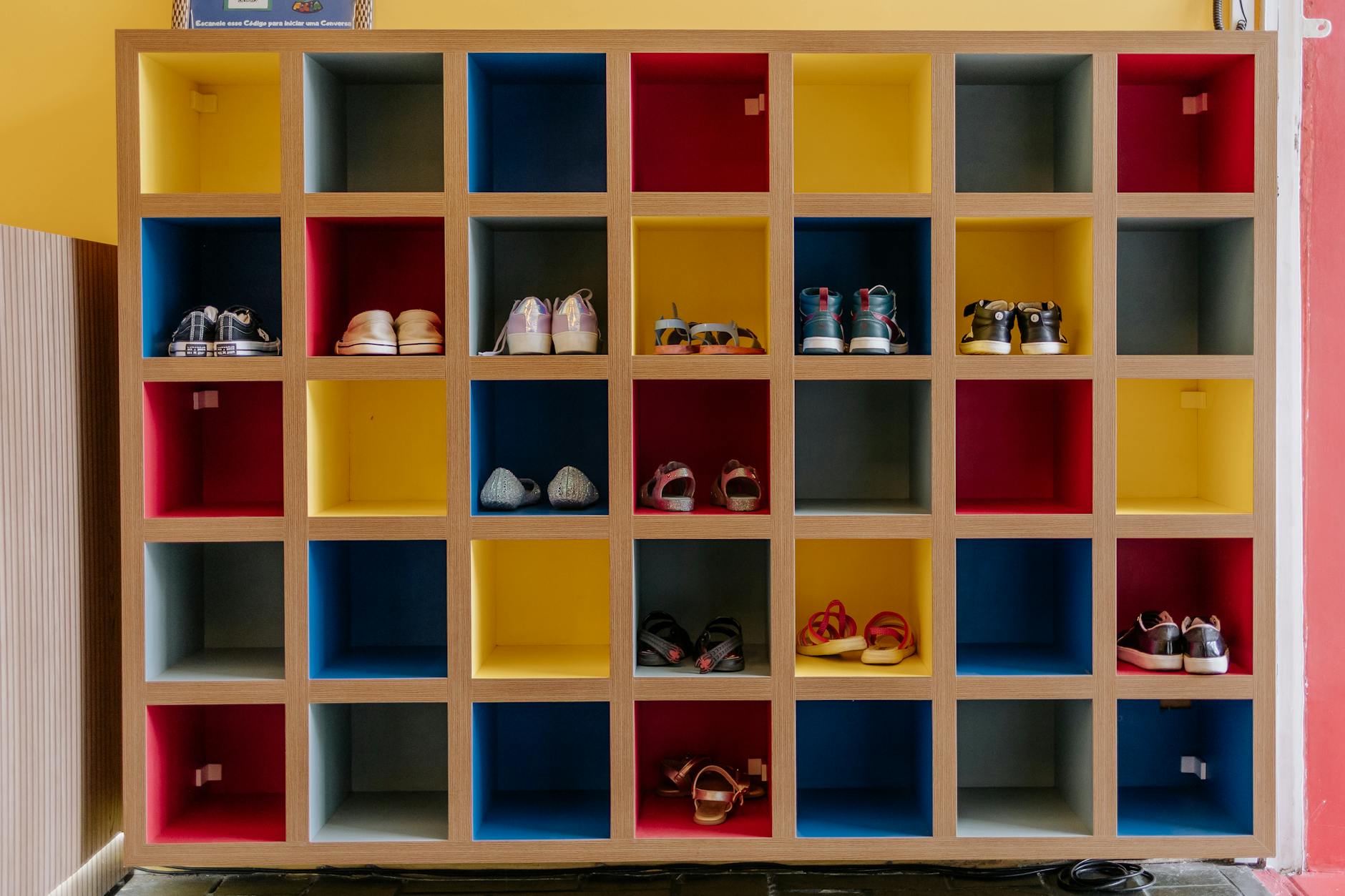
Living in compact quarters requires every storage decision to justify its footprint. When searching for shoe storage ideas for small spaces, the goal is not merely aesthetic containment but functional efficiency that preserves your floor plan and your footwear investment. Whether you inhabit a studio apartment or a narrow Victorian terrace, the principles remain identical: measure precisely, prioritize accessibility, and calculate cost per pair stored.
⚡ In a Rush? Key Takeaways
- Vertical systems cost $2–$4 per pair stored, vs. $8–$12 for freestanding furniture.
- Wall-mounted systems save floor space, reducing indirect costs in premium rentals.
- Canvas over-door organizers with padded hooks protect rental doors.
- ✅ Measure your shoes to optimize shelving space and prevent wasted storage.
Which shoe storage ideas for small spaces offer the best cost per square foot?
Vertical wall-mounted systems and rolling under-bed bins maximize capacity at $2–$4 per pair stored, significantly less than freestanding furniture at $8–$12 per pair.
When evaluating storage economics, divide the total system cost by the number of pairs it accommodates. A $120 freestanding rack that holds ten pairs costs $12 per pair annually, assuming a five-year lifespan. Conversely, a $45 over-door system storing twelve pairs reduces your cost to $3.75 per pair. Wall-mounted wire grids offer similar efficiency, requiring only $30–$40 in materials while reclaiming vertical square footage that would otherwise remain dormant.
Consider also the indirect cost of floor space. In urban rentals where square footage commands premium pricing, a shoe cabinet consuming four square feet of floor space effectively costs $40–$80 per month in lost living area, depending on your local market rates. The vertical mounting system Greta recommends utilizes wall studs to support thirty pounds per shelf, eliminating floor-based real estate consumption entirely.
| Option | Key Stat | Best For |
|---|---|---|
| Vertical wall-mounted systems | $2–$4 per pair stored | Maximizing capacity |
| Rolling under-bed bins | $2–$4 per pair stored | Utilizing under-bed space |
| Freestanding furniture | $8–$12 per pair stored | Larger collections |
Do over-the-door shoe organizers damage rental doors?
Quality canvas organizers with reinforced hooks distribute weight safely without scratches; avoid wire racks that chip paint and cost $15–$25 to replace when moving out.
The anxiety of forfeiting security deposits often prevents renters from utilizing door-mounted solutions. However, modern canvas organizers with padded hooks distribute weight across the door’s structural frame rather than relying on adhesive or tension. Look for models with individual reinforced pockets capable of supporting three pounds each—sufficient for leather boots or men’s dress shoes.
Wire racks present a different risk profile. Their metal hooks often lack protective coating and can scratch painted surfaces within weeks of installation. If your lease prohibits hardware installation, over-door systems provide twelve to twenty-four pairs of storage without violating rental agreements. The reinforced canvas design Greta recommends features soft-loop hooks that never contact the door face directly, protecting your deposit while expanding capacity.
| Option | Key stat | Risk profile |
|---|---|---|
| Canvas organizers with reinforced hooks | Safe weight distribution | Low risk |
| Wire racks | Can scratch painted surfaces | High risk |
How much vertical clearance do different shoe types require?
- Adult sneakers: 10–12 inches
- Tall boots: 14–16 inches
- Flats and sandals: 8 inches
Nothing wastes money faster than shelving that accommodates only half your collection. Before purchasing vertical storage, audit your inventory with a tape measure. Women’s pumps and ballet flats compress to under four inches in height, but require eight inches of vertical shelf space for easy retrieval without scraping heels against the shelf above. Men’s athletic shoes typically measure six to seven inches tall but need eleven inches of clearance when considering shelf thickness and finger space.
Boots present the greatest challenge. Ankle boots require thirteen inches, while riding boots demand sixteen to eighteen inches. If your collection includes both flats and knee-high styles, adjustable shelving costs 40% more than fixed units—approximately $65 versus $45 for a six-tier system—but prevents the inefficiency of empty wasted space above shorter pairs. Accurate measurement protocols prevent the common error of uniform spacing that leaves six-inch gaps above every flat, cumulatively wasting two feet of vertical storage.
Is building custom shoe storage cheaper than buying retail?
DIY plywood cubbies cost $35–$50 in materials versus $120+ for comparable retail units, requiring three hours of labor and basic woodworking tools for assembly.
For the hands-on homeowner, custom solutions offer both cost savings and dimension precision. A simple cubby system constructed from ¾-inch birch plywood runs approximately $40 in materials and provides twelve to sixteen compartments sized exactly to your footwear. Retail equivalents with similar capacity typically start at $120 and rarely match your specific spatial constraints.
The calculation must include tool rental or purchase if you lack a circular saw and drill. However, basic shoe cubbies require only straight cuts and simple butt joints—no complex joinery. Paint-grade plywood eliminates the need for expensive hardwoods while providing adequate strength for footwear weights. Greta recommends sealing the ply edges with iron-on banding to prevent splinters and moisture damage, adding $8 to material costs but extending lifespan by years compared to raw edges that absorb humidity.
What ongoing costs protect shoes in humid enclosed storage?
Silica gel packets cost $0.10 each monthly and cedar blocks run $1.50 per pair, preventing mildew damage that ruins $100+ leather footwear investments.
Enclosed storage beneath beds or inside ottomans traps humidity, particularly in climates with seasonal variation. Leather footwear stored in stagnant air develops mildew within six weeks during humid summers. The cost of prevention is minimal: reusable silica gel canisters absorb moisture for three months at $0.12 per recharge, while cedar blocks neutralize odors and deter pests at $1.50 per pair annually.
Consider this protection against replacement costs. A single pair of quality leather boots represents $150–$300 in value. Spending $4 annually on moisture control protects that investment more effectively than insurance. Replace silica packets when they feel saturated—typically indicated by color-changing beads—or when you detect any mustiness upon opening storage containers. The long-term cost analysis overwhelmingly favors preventive maintenance over replacement.
📊 Efficiency Verdict
Proactive moisture control costs $4 annually, protecting $150–$300 leather boot investments.
Do rotating seasonal shoe storage systems save money long-term?
Storing off-season pairs in vacuum bags under beds reduces active closet needs by 60%, allowing smaller, cheaper storage solutions for current footwear only.
Rotation systems require discipline but deliver significant spatial economies. By compressing winter boots into vacuum-sealed bags during summer months, you reduce their storage footprint by 70%. A $25 under-bed container holds eight pairs of compressed seasonal shoes, whereas the same quantity would require four square feet of closet shelving year-round.
The mathematics favor smaller active storage. If your daily footwear comprises four pairs, a compact four-tier wall rack ($35) suffices year-round, while seasonal items hibernate efficiently. This prevents the common error of purchasing storage sized for your entire collection simultaneously, which demands premium real estate constantly. The vacuum storage system Greta recommends includes hand pumps rather than electric models, saving $15 and avoiding battery dependency while achieving identical compression.
Selecting appropriate shoe storage ideas for small spaces ultimately returns to rigorous measurement and honest assessment of your daily routines. The most elegant system fails if it requires contortions to access your morning footwear. Prioritize solutions that maintain your collection’s condition while minimizing floor footprint—whether that means utilizing vertical wall space, reclaiming under-bed voids, or investing in precise DIY construction. Efficiency, in this context, means never storing what you do not wear, and never wasting space on what you do.